Duct Cleaning in Southeast Texas: When It Helps and When It Does Not
Duct cleaning gets advertised heavily and explained poorly. Some houses genuinely need it. Most do not. Here is how to tell the difference.
August 14, 2026 · 3 min read
What the Service Actually Involves
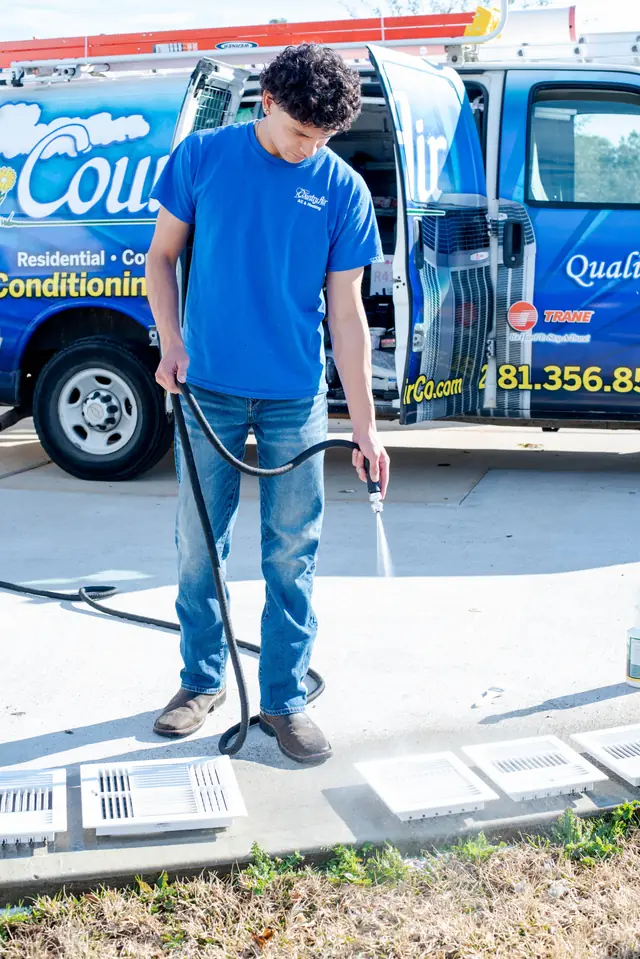
Duct cleaning means physically removing dust, debris, and biological growth from the supply and return duct runs in your home. A crew connects a truck-mounted vacuum to the duct system at the air handler, seals registers one at a time, and uses brushes or compressed air tools to dislodge buildup inside each run. The truck vacuum maintains negative pressure so the dislodged material does not blow back into the living space.
Done properly, it takes two to four hours on a typical residential system and requires equipment that cannot be improvised. A shop vacuum and a can of compressed air are not duct cleaning. Be wary of any offer priced at less than a couple hundred dollars for a whole house, as that price point generally reflects a service that will not reach the full duct system.
The Cases Where It Makes a Genuine Difference
- After construction or renovation. Drywall dust, insulation fibers, and sawdust get into any duct runs that were not sealed during the work, and they almost never are. These fine particles bypass the filter because they entered downstream of it. A post-construction clean-out is standard practice, not an upsell.
- Visible mould inside the duct. In Magnolia, Conroe, and Tomball, attic duct runs are in a hot, humid environment. Under-insulated flex duct sweats on the outside, and that moisture can produce mould growth inside boots and connections. If you pull a register cover and see biological growth, cleaning is appropriate, along with finding the moisture source.
- Rodent or pest entry. Attic-run ductwork is occasionally breached by rodents seeking a warm space. If there is nesting material, droppings, or an unexplained dead-animal smell from the vents, the affected section needs to be cleaned and likely replaced.
- A home you just purchased with no maintenance history. A one-time cleaning at move-in gives you a known starting point regardless of what the previous owners did or did not do.
When It Probably Does Not Matter
If your ducts have been in place for years without the specific triggers above, you change the filter on schedule, and nobody in the household has unexplained respiratory symptoms, cleaning is unlikely to produce a noticeable improvement. A thin film of settled dust on duct walls is normal and does not meaningfully restrict airflow or degrade air quality. The filter at the return handles the ongoing particulate load.
Claims that duct cleaning lowers energy bills are technically possible but practically insignificant unless the ducts are severely obstructed. A light dust coating produces no measurable change in system efficiency or airflow. If someone is leading with the energy savings pitch, that is a sign to ask more questions.
The Indoor Air Quality Case
The strongest legitimate case for duct cleaning is a household with occupants who have asthma, severe allergies, or compromised immune systems. Reducing the particulate reservoir in the duct system is a reasonable precaution in those situations. To get the full benefit, pair the cleaning with a MERV 13 or higher filter, sealed duct connections (mastic compound or metal foil tape at all joints, not the gray fabric tape that deteriorates in a few years), and if warranted, an ultraviolet air purifier at the evaporator coil.
Duct cleaning as a standalone measure, without addressing filtration and duct sealing, treats one variable out of several. It is not worthless in the right circumstances, but it is incomplete.
How to Avoid Getting Oversold
The duct cleaning industry has a persistent credibility problem, earned by operators who use coupon deals to get in the door and then pressure homeowners into UV treatments, biocide coatings, and sealant applications during the visit. A few markers of a legitimate job: the crew shows you before-and-after photos of the duct interior using an inspection camera, they use truck-mounted equipment, they hold a valid HVAC or mechanical contractor licence in Texas, and they do not apply any chemical treatment inside the duct system without explaining exactly what it is and why.
If you are not sure whether your ducts need cleaning, the right starting point is an HVAC maintenance visit. A technician can pull a register, use an inspection camera if warranted, and give you a straight answer. If cleaning is not needed, a good technician will say so.
Country Air — (281) 356-8564
Call (281) 356-8564More articles
Why Your AC Stops Working in the Middle of a Texas Summer
Triple-digit heat, a thermostat climbing past 80, and the air handler blowing warm. Here is what usually caused it and what to do in the next 30 minutes.
Attic Insulation in the Houston Area: What Your R-Value Actually Means
Your attic is the biggest source of heat gain in a Houston-area home. Getting the insulation right does more for your energy bill than almost anything else.